Hydraulic steel structures
Long strokes, high forces and corrosion protection at low speed – with traceable positioning instead of pure pressure actuation.
View hydraulic steel structures → Linear Technology
 Knowledge · Comparison
When does an electric linear actuator make sense? This page compares electric linear actuator, hydraulic and pneumatic cylinders objectively – by force, positioning, controllability, maintenance, cleanliness, energy and life-cycle cost. Hydraulics and pneumatics remain sensible in many applications; what matters is the task, not the principle.
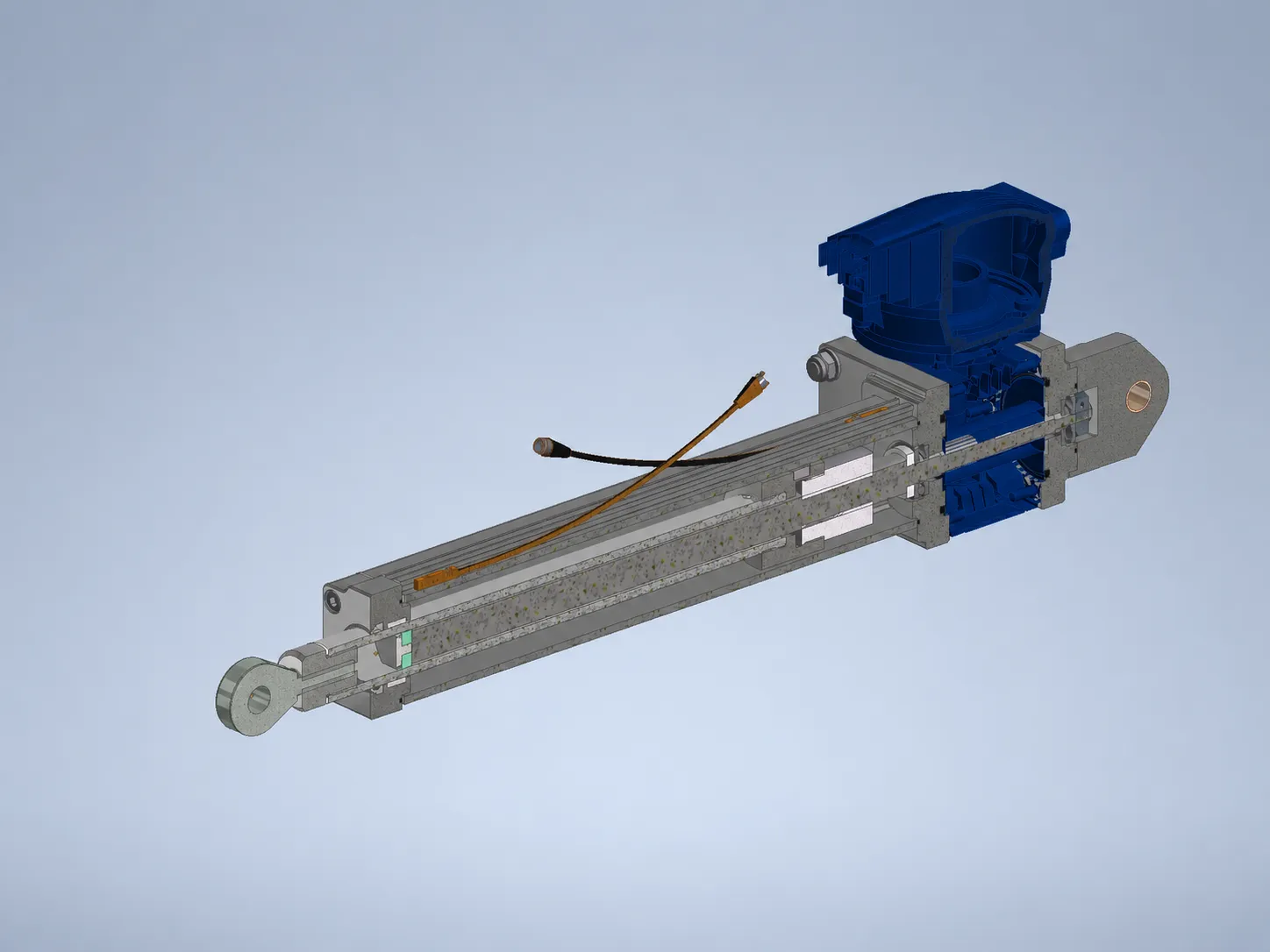
An electric linear actuator is the right choice when motion needs to become measurable, controllable and media-free – for example with defined positions, feedback, diagnostics, cleanliness, leak avoidance or retrofit. Hydraulics remain advantageous for very high forces in the smallest installation space, pneumatics for very fast, simple switching motions. Instead of favouring one principle across the board, S+R designs from the load case and the application and checks whether an electric solution makes sense.
Strengths
Electric linear actuators play to their advantages where a motion should not only take place but also be traceable, controllable and clean.
Reproducible intermediate and end positions via screw and encoder – repeatability without mechanical stops or constant pressure balancing.
The actual position can be passed to the control system as 0–10 V, 4–20 mA or digitally. Motion becomes measurable instead of estimated.
End positions, position, motor status and motion data can be integrated into PLC, motion control and service concept – the prerequisite for condition-based maintenance.
No hydraulic fluid and no compressed air at the moving unit. That matters for cleanrooms, food, medical technology and sensitive outdoor areas.
No oil or compressed-air escape at the moving unit – leakage is eliminated as a downtime, environmental and cleanliness risk.
Service focuses on mechanics, screw, bearings, motor and sensors – without central media supply, conditioning and pressure maintenance in the background.
Energy flows essentially during motion. There is no standing pressure and no leakage or conditioning losses as with compressed-air systems.
A clearly defined, control-open electrical interface (terminal box, signal) instead of system-specific hydraulic or pneumatic peripherals.
Fairly placed
Electric is not automatically better. For certain force, speed and cost profiles, hydraulics and pneumatics remain the technically and economically right choice.
Very high forces in the smallest installation space – hydraulics offer the highest force density.
Robust, permanent holding of very large loads, often with a simple design.
High tolerance to overload, impacts and tough operating conditions.
Where the power unit, lines and maintenance are already established, hydraulics often remain the economical choice.
Very fast, simple open/close motions between two end positions.
Inexpensive, rugged switching tasks without positioning requirements.
Where springy, compliant behaviour is wanted, compressed air plays to its strengths.
Where the compressed-air supply already exists, simple pneumatic cylinders are quick and cheap to integrate.
Comparison
The table contrasts the three drive principles objectively. There is rarely a blanket “better” – what matters is which criterion is decisive in your application.
| Criterion | Electric linear actuator | Hydraulics | Pneumatics |
|---|---|---|---|
| Force | Medium to heavy; up to ~500 kN in custom designs. | Very high – highest force density in a small installation space. | Low to medium. |
| Positionability | Freely definable intermediate positions, high repeatability. | Possible with control and sensor technology, but more involved. | Preferably end positions; intermediate positions only with extra effort. |
| Controllability | Speed and position directly controllable electrically. | Via valve technology and control loop, media- and temperature-dependent. | Limited, strongly pressure- and load-dependent. |
| Maintenance | Mechanics, screw, bearings, motor and sensors. | Seals, oil, filters and leak monitoring. | Conditioning, seals and leakage. |
| Cleanliness | Media-free; can be designed for cleanroom and food use. | Oil escape fundamentally possible. | Dry, but exhaust air or oiler depending on the system. |
| Power supply | Electrical; energy essentially only during motion. | Pump or power unit with standing pressure. | Compressor, conditioning and distribution. |
| Life-cycle cost | Higher purchase cost, but lower operation and service. | Medium purchase cost, media- and maintenance-intensive operation. | Low purchase cost; compressed air as an ongoing cost source. |
| Environment | Widely configurable (protection class, stainless steel, bellows). | Robust, but oil as an environmental concern. | Robust, simple and rugged. |
In practice
In these areas the electric alternative is particularly often sensible – usually because position, diagnostics, cleanliness or retrofit play a role.
Long strokes, high forces and corrosion protection at low speed – with traceable positioning instead of pure pressure actuation.
View hydraulic steel structures →Cyclic, controlled motion in machines that position reliably and integrate into the control system.
View machine engineering →Reproducible positions, defined load changes and a clean data connection for measurement tasks.
View test benches →Cleaning, stainless steel, media-free operation and traceability – what matters is protection class, material and a documented interface.
View pharmaceutical technology →Media-free replacement for hydraulics or pneumatics in the existing installation space – connected control-open to the existing system.
View retrofit →Reference: robust replacement of a maintenance-intensive adjustment in a steelworks →
Honest
An objective comparison also names where the electric linear actuator is not the first choice. We prefer to raise these points up front rather than after installation.
Where the goal is the highest forces in the smallest space, hydraulics often remain superior thanks to their force density. Electric custom actuators reach about 500 kN – beyond that, the design quickly becomes a case-by-case question.
For purely very fast open/close motions without positioning requirements, pneumatics are often simpler and cheaper – including the desired compliance.
Continuous or fast cyclic operation is feasible, but becomes a design topic: screw, motor and cooling must match it.
For very simple motions without measurement, diagnostic or cleanliness requirements, an electric solution can be oversized and more expensive.
Where a well-maintained hydraulic or compressed-air supply already exists, a switch has to pay off through benefits such as diagnostics, cleanliness or retrofit.
FAQ
No. It depends on the application. Electric linear actuators are particularly strong where motion needs to be measurable, controllable and media-free. Hydraulics and pneumatics remain the better choice for certain force, speed and cost profiles.
Above all when defined positions, feedback, diagnostics, cleanliness or leak avoidance become important – or in retrofit, when an existing cylinder is to be replaced media-free and control-open.
The standard sizes lie roughly between 8 and 80 kN. In the custom and heavy-duty range, forces up to around 500 kN are possible. For very high forces in the smallest installation space, hydraulics often remain advantageous.
In many cases yes. The decisive factors are the existing installation dimensions, the mechanical interface and the existing control system. S+R replaces control-open, so the electric actuator fits into the running system.
A rough description of the application, the approximate force or load, stroke and speed, the motion sequence and the environment. That is all it takes for an initial classification – S+R handles the precise design.
Force, stroke, motion and environment in keywords are enough. S+R assesses whether an electric solution is the right path – or whether hydraulics or pneumatics remain the better choice in your case.