Catalogue size only
A frame size is chosen before the application is clear – it rarely fits exactly.
 Linear Technology
 Knowledge · In depth
Good sizing does not begin in the catalogue, but with your application. This page shows which details on force, stroke, speed, duty cycle and environment really determine a custom electric linear actuator – and which of them you already need to know for a first inquiry. S+R handles the rest.
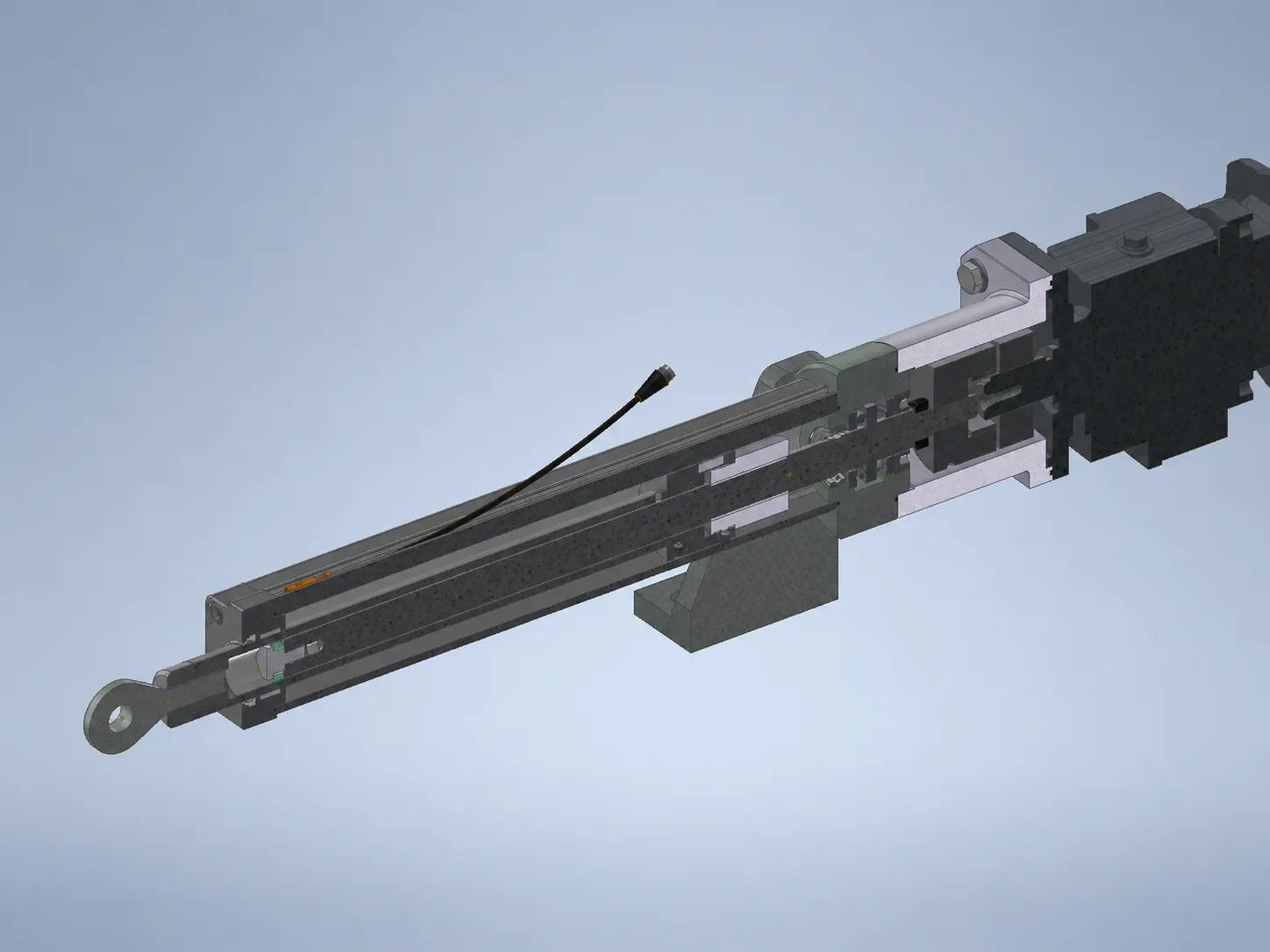
You do not have to specify an electric linear actuator down to the last detail in order to inquire. What matters is the application: what should be moved, how fast, how often and under which conditions? From this information S+R derives force, stroke, screw, protection class and control – including the safety factor and load case. A rough, honest description is worth more than an exact but unsuitable catalogue size.
Principle
A catalogue size describes a product, not your task. The same force can – depending on duty cycle, environment, load case and installation position – call for completely different electric actuators.
S+R sizes electric linear actuators from the load case forward, not backward from a standard size. That is why a precise description of the application is the fastest route to a fitting solution: from "what moves, how often and where to" follow screw, motor, protection class and control – as a modified standard or as a custom linear drive. An initial assessment is often possible with just a few keywords; S+R then takes care of the detailed technical sizing.
Sizing data
You do not have to answer every point exactly. Even a rough indication per line helps S+R narrow down the right design, screw and protection class.
The maximum push and/or pull force the actuator must deliver continuously – often the approximate load weight is enough instead of a finished kN figure. From it follow screw, motor and frame size. S+R adds the safety factor.
The usable travel from the retracted to the extended position. Stroke affects installed length, buckling load and guidance; with long strokes the mechanical design becomes more critical.
How fast the motion should run (mm/s) or how long a stroke may take. Speed, load and duty cycle decide between a ball screw and a trapezoidal screw.
How often and how long the actuator is in motion (cycles per hour, percent ED). It determines heat, screw choice and service life – realistic cycles matter more here than a wishful value.
Pushing or pulling, static or dynamic, with shocks or lateral forces? The load case affects guidance, mounting and safety factor.
Horizontal, vertical or inclined. With vertical installation, dead weight, self-locking and a possible holding brake come into play.
Indoors or outdoors, dry or wet, chemicals, food, salt. The environment determines material, sealing concept and protective measures.
Dust, splash or jet water, washdown capability. You do not need to know the exact IP class – the description of the environment is enough, and S+R derives the protection class and design (e.g. bellows).
Operating and ambient temperature. It affects lubricant, seals and, where applicable, the electronics.
Dust, chips, abrasive media. From these follow wipers, bellows and the maintenance requirement.
Is a limit switch enough, or do you need position feedback, synchronisation or defined intermediate positions? Limit switches, potentiometers, encoders and positioning control are possible; the position can be provided to your control system as 0–10 V or 4–20 mA.
How easy is the actuator to reach later on? Installation position, space and access determine maintainability, spare parts and retrofit capability.
Inquiry
On the left is what you should bring along for an initial assessment. On the right is what S+R clarifies technically together with you in the callback.
What is being moved and what the machine should do.
The load weight or order of magnitude of the force is enough.
Approximate travel and desired pace.
How often per hour, continuous or cyclic operation.
Indoor/outdoor, wet, cleaning, special media.
New system, series or replacement/retrofit; quantity if known.
Calculated by S+R from application and standard.
Ball or trapezoidal screw based on speed and duty cycle.
IP class and sealing concept from the environment.
Terminal box, 0–10 V / 4–20 mA, control integration.
Installation dimensions, mounting, connections – ideally by drawing.
Design for cycles, service and spare-parts strategy.
Pre-selection
The most common pitfalls do not arise from a lack of knowledge, but from the wrong order: the frame size first, then the application.
A frame size is chosen before the application is clear – it rarely fits exactly.
A kN figure without direction, shock and safety factor leads to under- or oversizing.
Continuous and cyclic operation are treated like single strokes – heat and wear rise unnoticed.
Protection class, temperature and contamination only surface after the first failure.
High speed with a self-locking trapezoidal screw – or vice versa – costs service life or function.
The actuator fits, but is barely maintainable or replaceable once installed.
Practice
Depending on the application, a different sizing value takes centre stage – from heavy duty in hydraulic steel structures to a retrofit in machine building.
Long strokes, high forces, water and corrosion at low speed. What matters is the load case, protection class and material – not the last decimal place of the force.
Fast, frequent motion with a defined position. What matters is the duty cycle, ball screw, encoder and integration with the control system.
Cleaning, stainless steel, media-free operation and traceability. What matters is the protection class, material and a clean, documented interface.
Replacement for hydraulics or pneumatics within the existing installation space. What matters is the installation dimensions, interface and control-open integration with the existing system.
FAQ
A description of the application, the approximate force or load, stroke and speed, the motion sequence and the rough environment. From this we create an initial assessment; the precise sizing follows in the callback.
No. An approximation or the load weight is enough. S+R calculates the safety factor and load case; an exact but wrongly assumed figure helps less than an honest order of magnitude.
Very important. It determines heat, screw choice and service life. Rather give realistic cycles or percent ED than a wishful value – it saves you surprises later.
Above all speed, duty cycle, repeatability and whether self-locking is desired. The basics are covered in the knowledge overview in the section on ball and trapezoidal screws.
Yes. Describe moisture, cleaning, outdoor use, dust or chemicals. From this we derive the IP protection class and design – such as bellows or stainless steel.
For a retrofit, what counts above all are the existing installation dimensions, the mechanical interface and the existing control system. S+R replaces in a control-open way, so the electric actuator fits into the running system.
Force, stroke, motion and environment in keywords are enough to get started. S+R clarifies the technical sizing in the callback – from a modified standard to a heavy-duty special actuator.